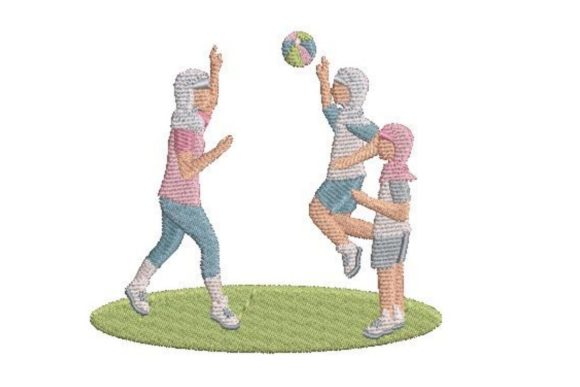
Faceless Mother and Children Playing
A Thoughtful, Warm Design for Small Business Branding
As an embroidery designer who’s created hundreds of commercial designs for cafés, boutiques, florists, bakeries, and handmade brands, my first impression of Faceless Mother and Children Playing is deeply positive — it feels warm, inclusive, and intentionally gentle. The “faceless” approach isn’t a limitation; it’s a strength for branding. It avoids age, ethnicity, or stylistic specificity, making the design universally resonant across diverse customer bases. Visually, it leans into soft elegance — not overly rustic, not starkly modern — but quietly timeless. That makes it ideal for businesses that want to communicate care, connection, and authenticity without leaning into cliché or sentimentality.
Real-World Performance Across Merchandise Types
Faceless Mother and Children Playing shines brightest where emotional resonance matters: embroidered patches for staff aprons at a family-owned bakery, chest accents on linen tote bags for a local florist, sleeve details on unisex work shirts for a creative studio, or cap embroidery for a children’s wellness brand. Its composition — likely balanced with open negative space and flowing outlines — translates well to custom apparel and small business merch. As an embroidered patch, it holds up beautifully when stitched on twill or denim backing, especially when paired with subtle thread colors like heather grey, oatmeal, or sage green.
For boutique merchandise — think gift tags, reusable produce bags, or branded tea towels — this machine embroidery design adds quiet sophistication. It also works powerfully as a tote bag design when scaled to 3.5–4 inches wide: large enough to read clearly, small enough to preserve fabric drape. On caps, it performs best on structured front panels (not curved visors) — the implied movement in “playing” suggests fluid lines that benefit from stable, flat surfaces.
Where Caution Is Essential
While versatile, Faceless Mother and Children Playing demands thoughtful execution in certain contexts. Avoid using it below 2.25 inches wide — fine details like interwoven limbs or delicate clothing folds may collapse or stitch poorly on tiny embroidered patch sizes. Cap fronts under 3 inches or curved surfaces like baseball hat crowns risk distortion, especially if the original embroidery file includes tight curves or high stitch density. Likewise, dark uniforms or textured fabrics (like heavy canvas or bouclé) require extra attention: test thread colors for contrast, and always use cutaway or tear-away stabilizer to prevent puckering around layered elements.
Frequent washing — common for aprons, staff shirts, or reusable totes — means reviewing fill stitch direction and underlay density. If the design includes dense satin borders or intricate inner fills, confirm with your digitizer whether it’s optimized for durability. Also, avoid placing it near seams, pockets, or hems where fabric tension shifts during wear or laundering.
How It Strengthens Brand Identity and Customer Trust
This design doesn’t shout — it invites. For small businesses, that’s gold. A café embroidering Faceless Mother and Children Playing onto barista aprons signals warmth and community without being prescriptive. A pet brand using it on organic cotton tote bags subtly ties caregiving values across species. That emotional alignment builds brand identity through consistency and empathy — not logos or slogans.
Customers recognize authenticity in handmade presentation. When applied cleanly to quality fabric, Faceless Mother and Children Playing elevates perceived product value. It tells buyers: *This isn’t mass-produced. This was chosen with intention.* That perception boosts engagement — especially on Etsy or local markets — where shoppers seek meaning alongside utility. Used alongside other design assets, it creates visual harmony: imagine pairing it with simple monogrammed initials or minimalist botanical motifs. Consistency here reinforces professionalism and trust.
Practical Designer Notes Before Production
Before stitching Faceless Mother and Children Playing into your next batch of commercial embroidery projects, follow these field-tested steps:
- Always run a printable mockup first — view it in black and white to assess balance, spacing, and silhouette clarity.
- Test at your smallest intended size (e.g., 2.5” for patches) on actual fabric — not just screen preview.
- Check thread color contrast on your target material: light threads on dark fabric need denser underlay; dark threads on light fabric benefit from softer top-stitch tension.
- Inspect spacing between elements — especially where limbs meet or fabric overlaps — to ensure no gaps or unintended “floats.”
- Confirm hoop size compatibility with your machine and frame setup. Oversized versions may require re-hooping or multi-position stitching.
- Use appropriate stabilizer based on fabric texture: cutaway for knits, tear-away for wovens, fusible for lightweight linens.
- Create a physical sample for client approval — never rely solely on digital proofs for emotional designs like this one.
- Compare it beside your existing design assets — does it share weight, rhythm, and tone? Does it support your broader visual language?
- Verify commercial licensing before use — since this is a digital embroidery file, confirm you’re cleared for resale, promotional use, and client projects.
Final Thoughts for Embroidery Shops and Creative Businesses
Faceless Mother and Children Playing isn’t just another Embroidery design in the Family category — it’s a strategic asset. It meets the nuanced needs of small business owners who want merchandise that feels personal but remains scalable, emotional but never exclusive, detailed but still production-friendly. Whether you're digitizing for a local florist’s gift line or producing apron embroidery for a Montessori school, this machine embroidery design delivers quiet impact. Just remember: its warmth comes from precision in execution — not just concept. Treat it with the same care you’d give a signature logo, and it’ll become a trusted part of your small business merch toolkit for seasons to come.