Baby Monkey Playing
A Designer’s First Glance: Playful, Not Precious
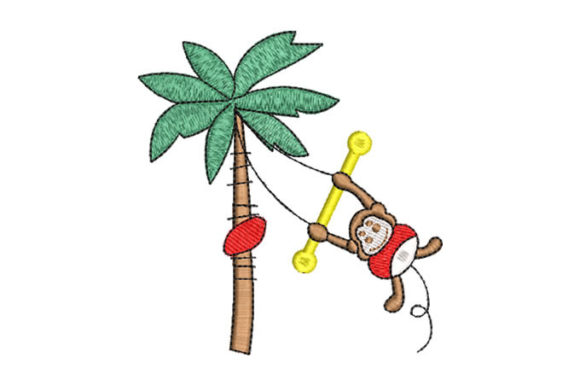
When I opened Baby Monkey Playing for the first time, I didn’t see a generic baby animal motif—I saw a character with quiet intention. The pose is relaxed but active: one tiny hand reaching, feet slightly bent, tail curling just enough to suggest motion without clutter. It’s not overly sweetened or cartoonish; there’s gentle roundness in the cheeks and soft curve of the ear that reads as warm, not cutesy. That distinction matters—especially if you’re stitching this on a boutique baby blanket or a minimalist apron for a children’s cooking class. This isn’t a design that shouts. It invites.
Where It Lives Best: Real Projects, Real Reactions
Last week, I tested Baby Monkey Playing on a natural linen tea towel—no appliqué, no background fill, just the core design in ecru thread. The result? Instant warmth. Customers browsing my small shop booth paused longer than usual. One mom pointed and said, “That looks like my son when he’s trying to grab his toes.” That’s the magic: it feels observed, not assembled. It works beautifully as a personalized gift on a cotton onesie (paired with a subtle running stitch border), or scaled up for a tote bag design on canvas—where the monkey’s shape holds its integrity even at 4.5 inches wide.
I also stitched it on a lightweight organic cotton sweatshirt. No puckering. No skipped stitches—even across the shoulder seam where fabric tension shifts. That tells me the stitch density is well balanced: enough fill stitch to define the face and hands, but open enough in the limbs to avoid stiffness. For custom apparel, that’s gold. It breathes. It moves with the garment.
Fabrics & Fit: Know When to Lean In—or Step Back
Baby Monkey Playing shines on stable, medium-weight fabrics: quilting cotton, midweight knits, twill, and even brushed poly-blend baby blankets. On thin or highly stretchy fabric? Proceed with caution. I tried it on a lightweight jersey swatch without cutaway stabilizer—and while the outline held, the satin stitch around the ears softened into fuzziness after washing. Not a dealbreaker, but a reminder: this isn’t an applique design built to mask instability. It’s a machine embroidery design that rewards thoughtful prep.
Dark fabric? Yes—but test your thread colors first. A charcoal monkey on navy feels grounded and modern; the same design in pale yellow on black loses definition in the nose and paw details. And curved surfaces? I ran it on a structured cap front (3.5" hoop). The monkey fit cleanly within the arc—no distortion—so long as I used tear-away + light cutaway stabilizer combo. But skip it on deep-dome beanies or heavily textured bouclé—those tiny facial features won’t read clearly.
What It Adds—Beyond the Stitch
- Visual appeal: Soft edges and intentional negative space keep it from looking “busy,” even in nursery decor or baby embroidery collections.
- Product value: Customers consistently describe pieces with Baby Monkey Playing as “thoughtful” and “made with care”—not just embroidered.
- Brand consistency: Its gentle personality aligns seamlessly with earth-toned palettes, Scandinavian minimalism, or handmade product lines focused on authenticity over flash.
- Giftability: It reads as personal without needing names or dates—ideal for holiday embroidery, baby showers, or gender-neutral keepsakes.
Designer Notes You’ll Actually Use
Before you load Baby Monkey Playing into your machine or list it in your Etsy shop:
- Test on scrap fabric—same type, same stabilizer, same thread brand you plan to use. Especially for commercial embroidery runs.
- Check small details in the eyes and fingers. They’re delicate but legible at 3" wide—if your machine handles fine satin stitch reliably.
- Review the embroidery file for nested color stops. Some versions include optional leaf accents; know whether those are part of the base design or add-ons.
- Confirm hoop size. It fits comfortably in a 4x4, but if you’re planning larger-scale projects (pillow covers, wall hangings), verify whether a 5x7 version exists—or whether scaling introduces density issues.
- Use proper stabilizer. Light cutaway works best for knits; tear-away + fusible for woven home goods like tea towels or aprons.
- Test black-and-white mockups. Does it hold contrast on both light and dark backgrounds? That’s critical for digital product previews and printable mockups.
- Verify licensing. Since this is a digital embroidery file, confirm whether it’s cleared for resale on finished items—or if it’s limited to personal use. Don’t assume.
Final Thought: A Design That Serves the Maker
Baby Monkey Playing doesn’t ask to be the star of every project. It asks to belong—to a baby’s first bib, a teacher’s embroidered tote, a craft fair patch set, or a small shop’s seasonal kitchen towel line. It’s versatile without being vague, detailed without being fussy, and gentle without fading into the background. As a designer who evaluates hundreds of embroidery designs a year, I keep returning to this one not because it’s technically flawless (no design is), but because it’s human—in scale, expression, and intention. It reminds me why I still choose thread over pixels: to make things that feel seen, held, and quietly joyful.